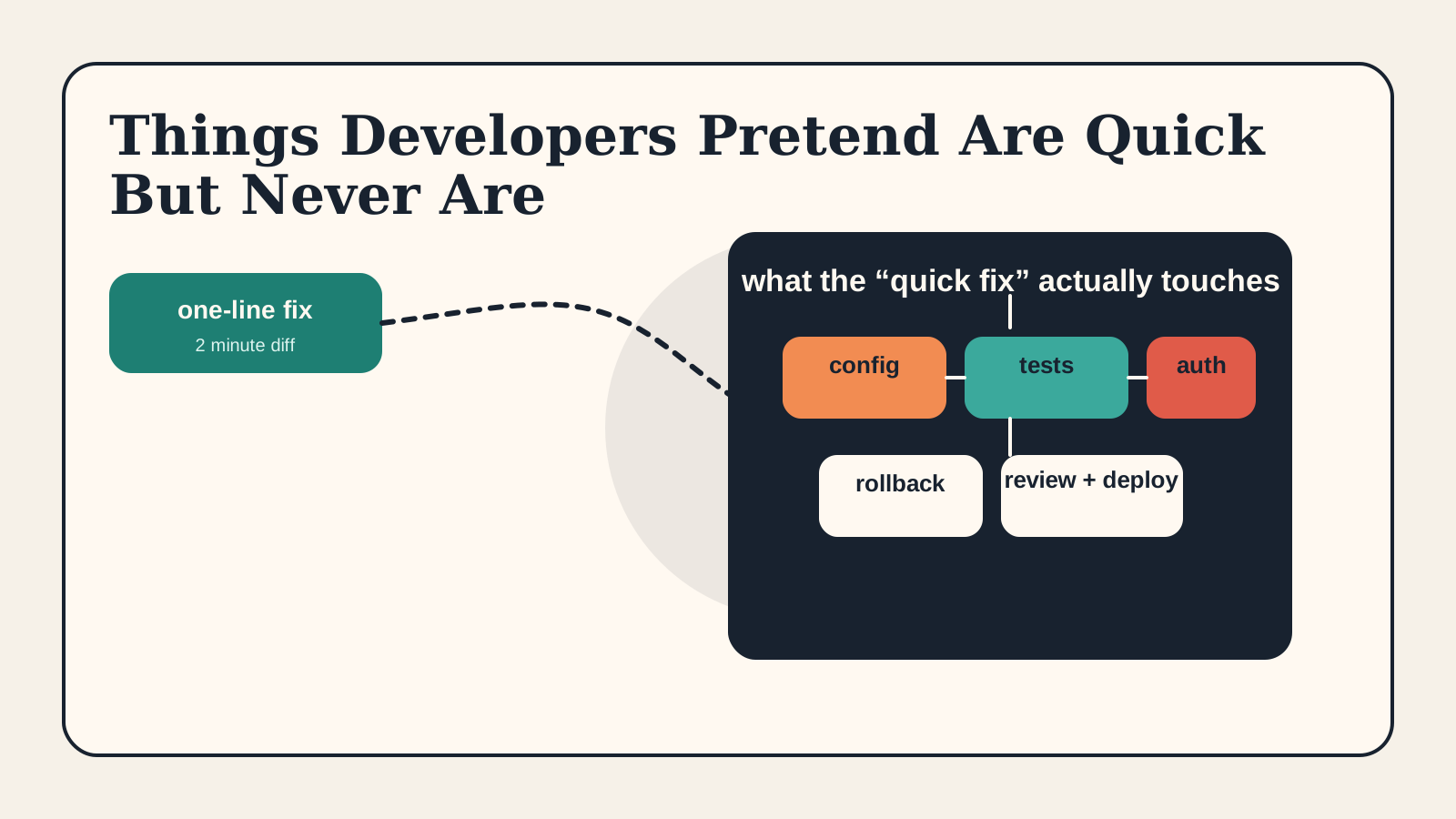
"This should be quick" is one of the most expensive sentences in software engineering.
It usually appears right before a developer opens a file with confidence, changes one line in under two minutes, and then spends the next three hours discovering that the line was attached to an environment variable, a flaky test, a cache, a migration, a mobile client, and one deeply committed assumption from last October.
The code change was quick.
Everything attached to the code change was not.
That is the real trap. Engineers often estimate the visible edit and forget the invisible system around it: validation, rollback, compatibility, coordination, and the small matter of proving the thing is safe to ship.
This article is a field guide to the software tasks developers keep calling quick even though history, logs, and calendar events keep disagreeing.
The Short Answer
The reason these tasks are never quick is simple: typing is local, but consequences are not.
| The supposedly quick thing | What actually takes the time | Why it expands |
|---|---|---|
| Config change | environment drift, restarts, validation | the config is shared and stateful |
| Dependency update | breakage hunting, changelogs, peer conflicts | version changes are rarely isolated |
| CSS fix | responsive fallout, inherited layout debt | UI behavior is connected in awkward ways |
| Auth tweak | cookies, expiry, redirects, sessions | boundary behavior matters more than the line edit |
| Field rename | contracts, analytics, clients, tests | names leak across the stack |
| Rebase | stale context, conflicts, hidden behavior shifts | the branch has aged while everyone kept working |
| One-line fix | proof, monitoring, rollback confidence | implementation is cheap, confidence is not |
If you want one durable rule, it is this: when a task touches a shared boundary, it is no longer a quick task. It is a small change with a large blast radius.
1. The Five-Minute Config Change That Needs Three Environments And A Prayer
Config changes are elite performers in the category of work that looks trivial in a diff and strangely spiritual in production.
You change a timeout from 10 to 30. Or flip a feature flag. Or add one environment variable that clearly, obviously, definitely exists everywhere.
Then reality arrives in order:
- local works because your shell has the variable already
- staging fails because one service did not get redeployed
- production has the variable, but the worker process still reads the old value
- one teammate has a
.envfile copied from a branch that should have been deleted months ago
By this point the "quick change" has become an archaeology project with side quests.
This is why configuration deserves the same respect as code. It has versions, dependencies, rollout behavior, and failure modes. The difference is that config problems are often harder to see because they live outside the line you changed.
Practical habit: if a change depends on configuration, treat verification steps as part of the estimate. Check source of truth, restart behavior, environment parity, and rollback before calling it small.
2. Quick Dependency Update, Slow Existential Crisis
Dependency updates come with a uniquely confident form of optimism.
The pitch is always clean: "It is just a patch version." That sentence has started enough trouble to deserve its own incident category.
Most updates are not hard because clicking the new version number is hard. They are hard because the real work starts after the edit:
- reading the changelog to find the one breaking note hidden between performance improvements
- dealing with a peer dependency that disagrees with your package manager and your afternoon plans
- discovering a build-time warning that was actually a runtime behavior change wearing a fake mustache
- deciding whether the failure is your code, the dependency, the bundler, or the sixth transitive package nobody knew was important
This is why dependency work is less like a quick replacement and more like a negotiation with your tooling supply chain.
The useful mindset is not "upgrades are quick." It is "upgrades are small migrations." Some are tiny. Some are socially acceptable ambushes.
Practical habit: when the update touches a widely used library, estimate the reading, test-running, and rollback work too. The install command is not the task. It is the first line of the task.
3. Tiny CSS Fix, Full-Size Layout Mystery
Frontend engineers know this one by heart. Backend engineers also know it, usually from the day they said "I will just move this button slightly" and then learned new respect for spacing systems.
You change one margin.
It looks fixed.
Then you check mobile.
Then tablet.
Then the modal. Then the loading state. Then the German translation. Then the one screen where the same component is inside a container with rules written during a different political era.
CSS is rarely difficult because the syntax is complex. It is difficult because layout is contextual. The bug is in one place. The cause is often in a nearby place. The consequences are in four more places that did not volunteer for this experience.
Practical habit: when a visual fix touches shared components, test neighboring states on purpose. A quick UI change becomes expensive exactly when you only validate the happy path.
4. Simple Auth Change, Complex Regret
There are no simple auth changes. There are only auth changes that have not shown their full personality yet.
You tweak cookie settings. Or token expiry. Or one redirect rule. On paper it is one condition and a prayer.
In practice, auth lives at the boundary between browser behavior, server behavior, environment differences, and user state. That boundary is where "small" changes go to become educational.
Common outcomes include:
- login works locally and loops in production
- a session refresh path breaks for only one class of users
- mobile behaves differently from web because storage assumptions are not actually shared
- an apparently harmless change quietly logs people out every few hours
This is why Authentication Explained is long. The line of code is usually short. The number of states around it is not.
Practical habit: when a change touches auth, think in flows instead of edits. Sign in, refresh, expiry, logout, revoked session, multiple tabs, and environment-specific cookie behavior should all be in scope before you call it done.
5. “Just Rename This Field” Is How You Wake Up Half The Stack
Field renames are one of the purest examples of a change looking local while being completely non-local.
You are not renaming a field.
You are renegotiating an agreement.
That agreement might include:
- frontend assumptions
- API consumers
- analytics events
- saved queries
- background jobs
- tests and fixtures
- old dashboards that somehow still decide executive confidence
The database column or response property is the easy part. The hard part is remembering how many places started depending on that name while nobody was paying attention.
This is the same reason API Design That Survives Real Teams spends so much time on compatibility. Once a name crosses a boundary, it stops being a refactor and starts being change management.
Practical habit: when renaming a shared field, assume consumers exist until you prove otherwise. Compatibility layers, deprecation windows, and temporary dual-writing are often cheaper than confidence theater.
6. Quick Database Change, Long Rollback Conversation
The sentence "it is just a small schema change" should be handled with the same caution as "we can clean it up later."
Database changes look tiny because the migration file is tiny. But the real surface area includes:
- locking behavior
- backfill time
- null handling
- deploy order
- compatibility with old application code during rollout
- the very awkward question of what happens if you need to revert at 4:47 PM
A schema migration can be logically correct and still operationally rude.
This is where experienced engineers slow down on purpose. Not because the SQL is scary, but because data changes have memory. Once production state moves, the cost of being wrong is different.
Practical habit: estimate migrations in two parts: writing the change and proving the rollout path. If the second part is fuzzy, the task is not quick yet.
7. “Just Rebase It” Is How Afternoons Disappear
Rebasing is easy in the same way packing for a trip is easy before you open the closet.
The command itself is not the issue. The issue is that rebasing usually happens when a branch has already spent too long aging in public.
Now the quick task includes:
- conflict resolution in code you no longer fully remember
- test failures caused by adjacent changes you did not make
- re-reading your own diff to see whether the meaning changed during conflict resolution
- the small emotional question of whether a force push is about to surprise someone else
Git is not punishing you for using the wrong command. It is charging interest on delayed integration.
That is why your existing posts on Common Git Mistakes and How to Fix Them Safely and Why Small Pull Requests Save More Time Than Fast Coding resonate. The pain is usually not command syntax. It is letting the change grow old enough to become expensive.
Practical habit: if a branch is starting to feel historically significant, merge smaller slices sooner. The easiest rebase is the one you prevented.
8. It Is Just A One-Line Fix, Plus Several Hours Of Trust-Building
This is the king of the genre.
The one-line fix is often real. The code edit is genuinely one line. Sometimes the bug really does come down to one condition, one default, one missing null check, or one incorrect comparator.
What is not one line is everything required to believe the fix.
That usually means:
- reproducing the bug with confidence
- understanding why the failure happened in the first place
- proving the fix does not break a nearby path
- deciding whether you need a test, a metric, a log, or all three
- figuring out whether rollout should be immediate, guarded, or watched closely
Implementation is cheap. Confidence is expensive.
That is not wasted effort. That is the job.
The engineers who get bitten here are usually not careless. They are just estimating the edit instead of the evidence.
Practical habit: when someone says "it is just a one-line fix," ask the real question: "How long until we trust it in production?" That is the estimate you actually need.
Why These Tasks Keep Fooling People
These tasks are not deceptive because developers are irrational. They are deceptive because software hides cost in places people do not see at first glance.
The recurring sources of surprise are usually the same:
- shared boundaries make local edits non-local
- old systems contain historical assumptions that are invisible until touched
- validation work is often larger than implementation work
- rollback and observability are part of delivery, not extras
- coordination cost appears late, which makes the early estimate look falsely clean
In other words, many engineering tasks are not hard because they require lots of typing. They are hard because they require confidence across a system that was built by multiple people over time under imperfect conditions. Which, unfortunately, is most systems.
How To Stop Lying To Yourself About “Quick” Work
You do not need to become pessimistic. You just need a better checklist.
Before calling a task quick, ask:
- Does this touch a shared boundary such as config, auth, data, contracts, or UI components?
- What proof will I need before I trust this change?
- If this goes wrong, is rollback obvious?
- Which environment is most likely to disagree with local?
- What unrelated system has quietly attached itself to this decision?
If those questions all have short, boring answers, then yes, maybe it really is quick.
That does happen.
Just not as often as standup estimates suggest.
The Real Takeaway
Software is full of small edits with large consequences.
That does not mean engineering is doomed, or that every change deserves ceremony. It means the visible edit is only a fraction of the real work. The hard part is often not writing the fix. The hard part is understanding the system well enough to change it without starting an entirely different conversation.
"Quick" is usually a statement about typing, not about systems.
And systems, as usual, would like a word.
Comments
Join the discussion on GitHub.