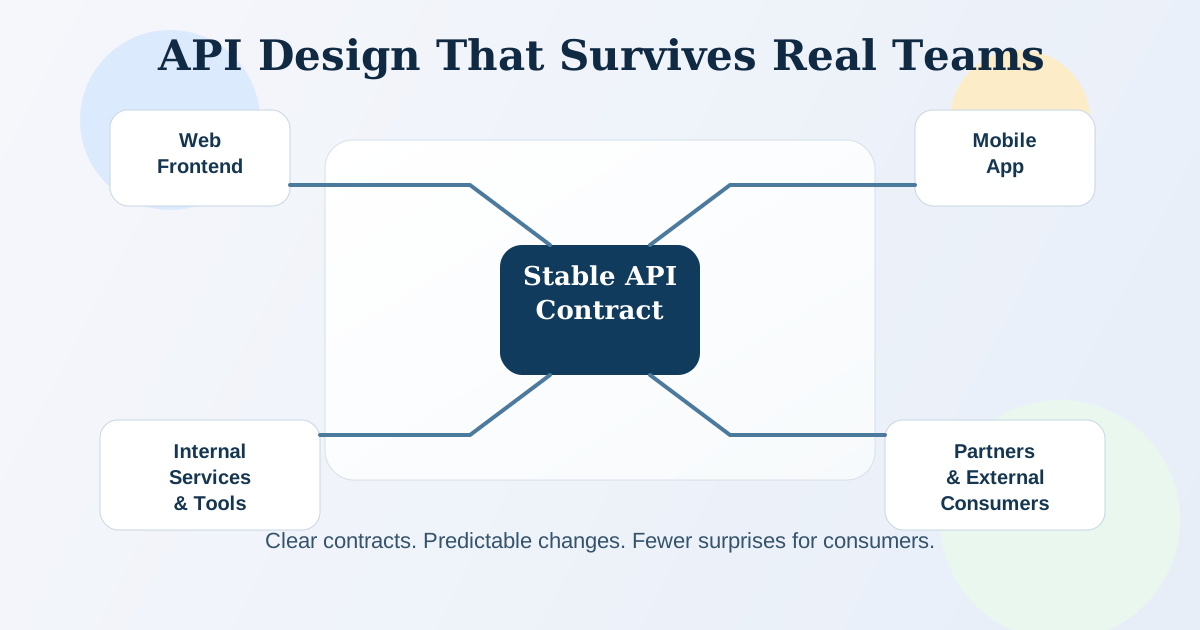
Your API started as one endpoint for one frontend.
Then mobile arrived. Then an internal admin tool. Then another backend service started consuming the same contract. Then a partner integration showed up with longer release cycles and less patience for breakage. What used to feel like a neat little implementation detail quietly became infrastructure.
That is where most API advice starts failing.
The problem is not that engineers do not know what GET or POST means. The problem is that an API is easy to design for day one and hard to design for year three. A response rename that feels harmless to the team shipping it can break a mobile release already in App Store review. A search endpoint without pagination works fine in development, then melts under real data volume. An error response that made sense to the original author becomes impossible for five different clients to handle consistently.
This is why API design matters more than most teams think. Not because APIs are elegant artifacts. Because they become contracts other teams build against.
This guide is about designing APIs that survive that pressure. We will cover naming, resource shape, pagination, filtering, error handling, retries, versioning, and the habits that keep an API usable after multiple teams depend on it.
The Short Answer
If you only want the operating model, it is this:
- Treat every public field, parameter, and endpoint as a contract you may have to support longer than you expect.
- Optimize for clarity and consistency before cleverness.
- Design pagination, filtering, error shapes, and retry behavior early.
- Prefer additive changes over breaking changes whenever possible.
- Version sparingly, deprecate deliberately, and assume consumers upgrade slower than you want.
- Review APIs from the consumer's point of view, not just the implementer's.
That is the short version. The rest of the article is about applying it without creating an API that looks tidy in docs but painful in production.
Why So Many APIs Become Hard To Change
A lot of API pain is self-inflicted, but not because teams are careless. Usually it starts with one of these assumptions:
- it is only an internal API
- we can clean it up later
- clients can adapt
- we will version it when needed
- the frontend team can work around it
Those assumptions collapse once other teams depend on the contract.
An internal API is still an API. If three services call it, you already have external consumers from the point of view of change management. "We can clean it up later" usually means "we will carry this shape forever because changing it later has a coordination cost." "Clients can adapt" is easy to say when you do not own the mobile release cycle, the partner integration, or the third-party SDK built on top of your endpoint.
This is the same pattern you see in other parts of software engineering. Auth looks simple until boundary behavior matters. Caching looks easy until correctness and invalidation matter. SQL looks fine until real data volume shows the true cost of sloppy query design. APIs are no different. The interface is where deferred decisions come back with interest.
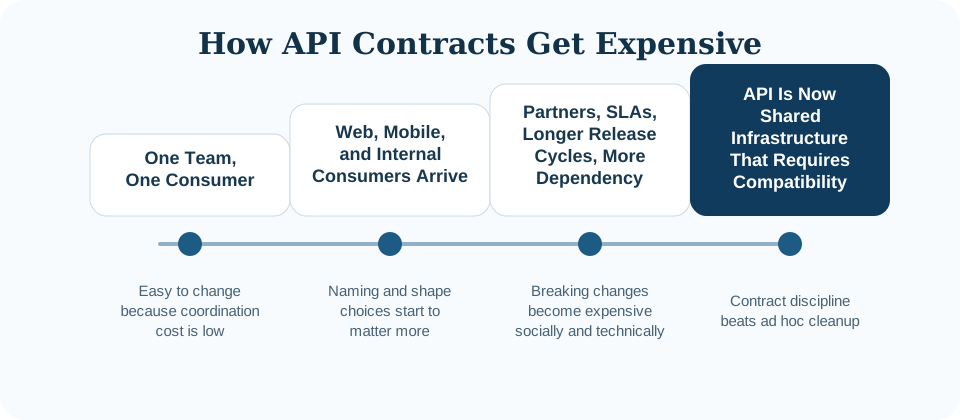
The teams that design stable APIs usually understand one thing early: the cost of changing an API is not measured in lines of backend code. It is measured in coordination, migrations, rollout risk, broken integrations, and lost trust.
The Real Mental Model: APIs Are Contracts
The cleanest way to think about an API is this:
An API is a long-lived contract between producers and consumers.
That sounds obvious, but teams routinely design APIs as if they are just transport wrappers around database queries. That mindset produces endpoints that are easy to ship and hard to live with.
A good API is not just "RESTful" or "fast." It is predictable under change.
| Quality | What it means in practice | Failure mode when missing |
|---|---|---|
| Clarity | names, fields, and behavior are obvious | consumers guess and build inconsistent logic |
| Consistency | similar problems are solved the same way | each endpoint feels custom and surprises clients |
| Compatibility | changes do not break existing consumers casually | clients pin old behavior or stop trusting updates |
| Operability | pagination, retries, rate limits, and errors are usable in the real world | integrations fail under load or partial failure |
| Predictability | similar inputs lead to similar shapes and status codes | consumers need endpoint-specific exceptions everywhere |
This framing changes how you review APIs.
Instead of asking "does this endpoint work," you ask:
- will another team understand this without a meeting?
- can a client recover from failure cleanly?
- what breaks if this field changes?
- what happens when the result set grows 100x?
- is this shape still reasonable when a mobile client and a partner both consume it?
That is a much better standard.
What Makes an API Good in Practical Terms
A good API does not force consumers to reverse-engineer your backend.
It makes common operations obvious. It limits ambiguity. It gives clients enough structure to automate safely. It behaves consistently enough that engineers can make reasonable guesses across endpoints. It also acknowledges that consumers do not all move at the same speed.
That means good APIs tend to share a few traits:
- resources are named clearly
- response shapes are stable
- lists are paginated predictably
- filters and sorting are deliberate, not ad hoc
- errors are structured for both humans and machines
- writes can be retried safely where needed
- changes are introduced additively when possible
- deprecations are treated as migrations, not announcements
Bad APIs often fail in the opposite direction. They expose implementation details, use inconsistent naming, return different error shapes per endpoint, and assume the consumer will figure it out.
Resource Design and Naming
Naming is one of the highest-leverage API decisions because consumers encode it everywhere: frontend code, mobile clients, scripts, dashboards, SDKs, docs, support playbooks.
A lot of API weirdness comes from designing endpoints around controller actions instead of domain resources.
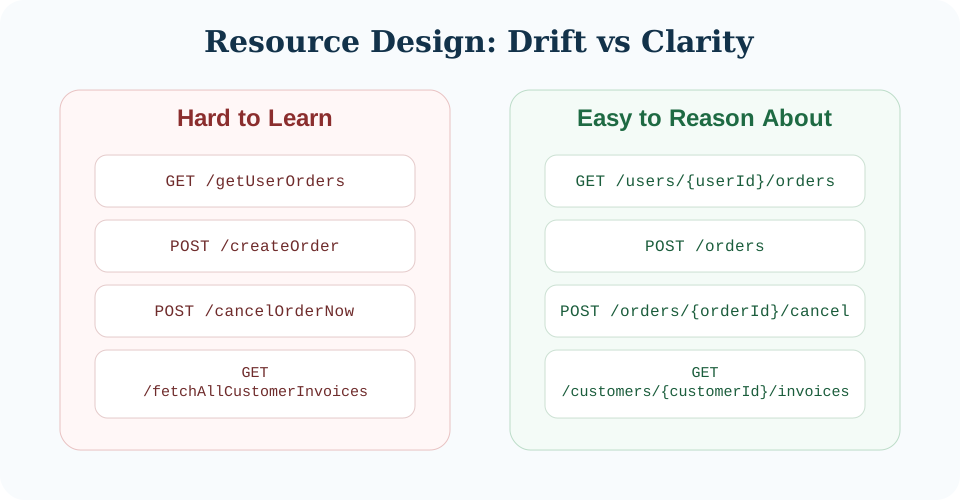
Compare these:
GET /getUserOrders
POST /createOrder
POST /cancelOrderNow
GET /fetchAllCustomerInvoices
Versus:
GET /users/{userId}/orders
POST /orders
POST /orders/{orderId}/cancel
GET /customers/{customerId}/invoices
The second set is not perfect because no naming scheme is, but it is much easier to reason about. It uses stable nouns, clear hierarchy, and predictable patterns.
That does not mean every API must become dogmatic REST theater. Sometimes an action endpoint is the right call. Cancellation, checkout, password reset, and other state transitions are often clearer as explicit actions than as tortured CRUD updates.
The point is not purity. The point is readability.
Good Naming Rules That Age Well
- Use nouns for resources and verbs only where the operation is genuinely action-like.
- Prefer one clear term across the API instead of synonyms like
customer,client, andaccountHolderfor the same concept. - Avoid leaking storage details such as table names or internal workflow steps.
- Keep path structures consistent across related resources.
- Avoid "misc" endpoints that become dumping grounds for unrelated behavior.
Bad Naming Usually Looks Like Drift
APIs get messy when different teams add endpoints over time without shared standards:
GET /users/{id}
GET /user-profiles/{id}
GET /profile?user_id=123
POST /user/updateEmail
PATCH /accounts/{id}
Every one of those may have made sense locally. Together they force consumers to memorize exceptions.
A practical rule: if a new engineer cannot guess the endpoint shape for a related resource with decent accuracy, the API probably lacks enough consistency.
Designing for Lists: Pagination, Filtering, and Sorting
Teams often treat list endpoints as the easy part. They are not.
A list endpoint without deliberate query behavior becomes one of the most painful parts of an API because it sits directly at the intersection of usability, performance, and compatibility.
Here is the simplest bad version:
GET /orders
That works until there are 40 orders. Then 4,000. Then 4 million. Now clients want pagination, filtering, sorting, date ranges, and sometimes field selection. If none of that was designed early, you end up bolting parameters on one by one.
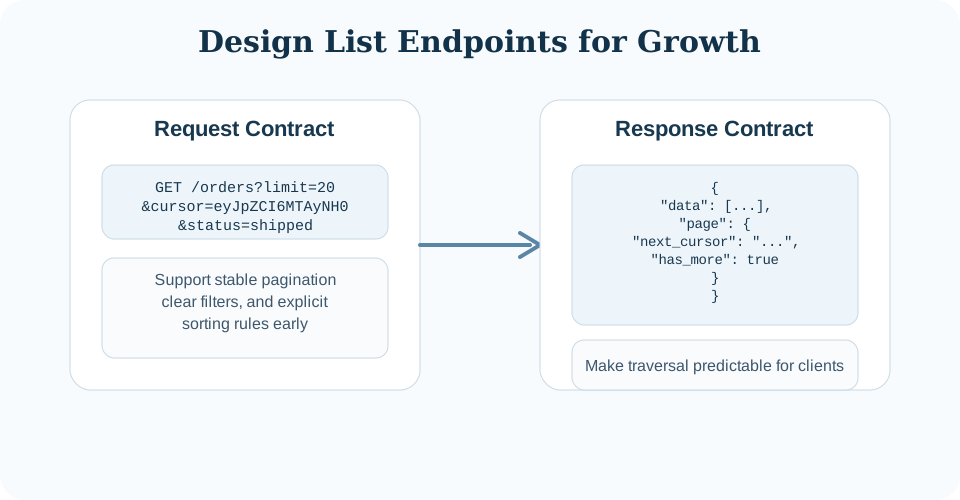
A better pattern is to define the contract up front.
GET /orders?limit=20&cursor=eyJpZCI6MTAyNH0&status=shipped&sort=-created_at
And return metadata that clients can actually use:
{
  "data": [
    {
      "id": "ord_1024",
      "status": "shipped",
      "created_at": "2026-05-29T10:22:00Z",
      "total_amount": 8400,
      "currency": "USD"
    }
  ],
  "page": {
    "next_cursor": "eyJpZCI6MTA0NH0",
    "has_more": true
  }
}
Offset vs Cursor Pagination
Offset pagination is easy to understand:
GET /orders?offset=40&limit=20
It is fine for small internal tools and datasets where consistency is not critical.
It starts to hurt when:
- result sets are large
- rows are inserted frequently
- clients need stable traversal through changing data
Cursor pagination is usually better for high-volume or user-facing systems because it handles growth and shifting datasets more predictably.
The real rule is not "cursor good, offset bad." It is "pick the pagination model your data shape can support, then use it consistently."
Filtering Should Be Intentional
Filtering is where APIs often leak query complexity back onto the consumer.
Good filtering:
- uses clear parameter names
- supports the dimensions clients genuinely need
- avoids one-off custom behavior per endpoint
- defines exact semantics for ranges, enums, and null handling
Bad filtering looks like this:
GET /orders?filter=true&value=recent
No one knows what that means without documentation or source code.
Better:
GET /orders?status=shipped&created_after=2026-05-01T00:00:00Z
It is obvious, predictable, and easier to evolve.
Sorting Needs Explicit Rules
If your API supports sorting, define the allowed fields and the direction syntax clearly. Do not let each endpoint invent its own format.
For example:
GET /orders?sort=-created_at
GET /users?sort=name
That is easy to teach and easy to consume.
This is also where API design meets database reality. Loose filtering and unbounded sorts are not just ugly contracts. They often become slow queries, expensive indexes, and performance regressions. If you have ever debugged query-shape problems in production, you already know that convenience at the API layer can create cost in the data layer.
Error Handling That Helps Clients Recover
A surprising number of APIs still treat errors as afterthoughts.
The result is usually one of two extremes:
- a vague blob like
{ "error": "something went wrong" } - a different structure for every endpoint because each team rolled its own
Neither helps the consumer.
Good error handling serves two audiences at once:
- engineers reading logs or debugging manually
- client code that needs to react programmatically
A useful error response usually includes:
- a stable machine-readable code
- a human-readable message
- optional field-level details for validation failures
- request or trace identifiers where helpful
For example:
{
  "error": {
    "code": "validation_failed",
    "message": "One or more fields are invalid.",
    "details": [
      {
        "field": "email",
        "issue": "must be a valid email address"
      }
    ],
    "request_id": "req_8f21c7"
  }
}
That gives both the frontend and the backend something useful to work with.
Use Status Codes With Discipline
Status codes are not enough on their own, but they still matter.
A sane baseline:
400for malformed requests401for unauthenticated requests403for authenticated but forbidden requests404for missing resources409for state conflicts422for semantically invalid input if your team distinguishes it from400429for rate limiting500for unexpected server failures
The key is consistency. If one endpoint returns 400 for a missing auth token and another returns 401, clients end up with endpoint-specific fallback logic. That is how APIs become tedious to consume.
Validation Errors Need Structure
Validation is one of the most common failure modes, so make it easy to handle.
Bad:
{ "error": "invalid request body" }
Better:
{
  "error": {
    "code": "validation_failed",
    "message": "Request body validation failed.",
    "details": [
      { "field": "currency", "issue": "must be one of USD, EUR, GBP" },
      { "field": "amount", "issue": "must be greater than 0" }
    ]
  }
}
That structure lets a client highlight fields correctly, log failures cleanly, and build reliable automation.
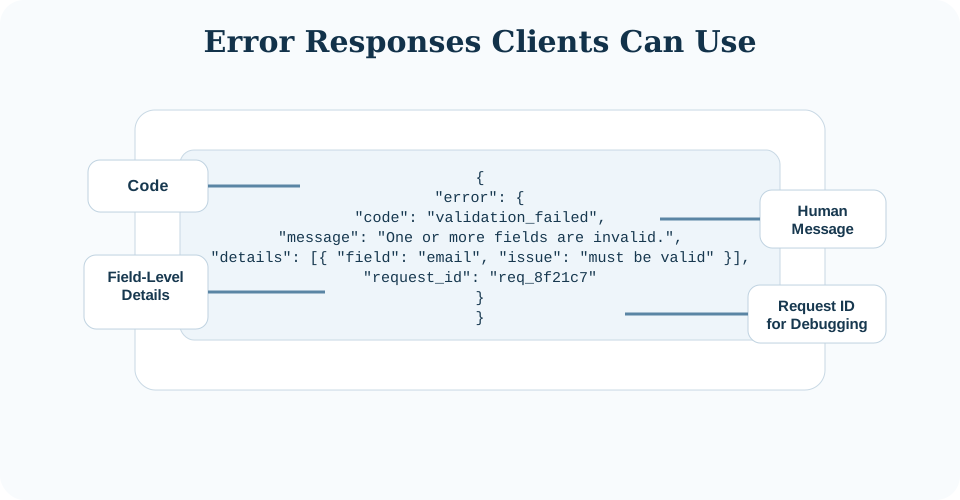
A practical litmus test: if a frontend engineer has to special-case the error format for every endpoint, your error design is too loose.
Idempotency, Writes, and Safe Retries
Read endpoints get more attention, but write behavior is often where API contracts become operationally dangerous.
Distributed systems retry. Browsers retry. Mobile networks drop. Background jobs replay. Payment providers time out. If your write API behaves unpredictably under duplicate requests, you do not just have a design flaw. You have a money, state, or trust problem.
POST, PUT, and PATCH Are Not Interchangeable
Use them deliberately.
POSTis usually for creating a new resource or triggering a non-idempotent action.PUTis generally for replacing a resource representation at a known location.PATCHis for partial updates.
You do not need to start theological arguments about HTTP semantics. You do need to be consistent enough that consumers know what to expect.
Idempotency Matters When Retries Are Plausible
If a client can reasonably retry a write because of timeouts or network uncertainty, think about idempotency before the problem appears in production.
Classic example:
POST /payments
Idempotency-Key: 2a6d7f43-8c95-4baf-88de-28e0fd4a9db1
If the first request succeeds but the response never reaches the client, the client should be able to retry with the same key and get the same outcome instead of charging the card twice.
A lot of teams think idempotency is only for payments. It is broader than that. Any operation where duplication is expensive or confusing can benefit from it:
- invoice creation
- order submission
- email-triggering actions
- provisioning workflows
- expensive asynchronous job submission
State Transitions Need Clear Conflict Behavior
When writes depend on current state, define the conflict behavior.
For example, what happens if a client tries to cancel an order that is already shipped?
Good API design does not hide that behind vague success responses. It makes the contract clear.
{
  "error": {
    "code": "order_not_cancellable",
    "message": "Shipped orders can no longer be cancelled."
  }
}
That may return 409, 422, or another agreed code depending on your standards. The important part is that clients can reason about it.
Versioning, Deprecation, and Breaking Changes
This is the part teams love to postpone.
Versioning sounds like future-you's problem until you need it. Then half the pain comes not from adding a version, but from all the undisciplined decisions made before that point.
The first thing to say is simple: versioning is not free.
Every version you introduce creates documentation overhead, testing overhead, operational complexity, and longer support tails. If a team reaches for versioning every time a contract gets awkward, they are often compensating for avoidable design churn.
Prefer Additive Change Over Breaking Change
A lot of API evolution can be handled additively:
- add a new optional field
- add a new endpoint
- add a new filter parameter
- add a new enum value if consumers are expected to handle unknown values safely
Breaking changes are different:
- renaming or removing fields
- changing data types
- changing validation rules incompatibly
- changing pagination behavior
- changing response shape in ways existing clients cannot tolerate
If you can solve the problem additively, do that first.
Internal APIs Still Need Compatibility Discipline
One of the most expensive lies in software is: "it is only internal."
Internal APIs often have the least disciplined consumers, the weakest docs, and the most hidden dependencies. That makes breaking them easier, not safer.
If another service, internal tool, or mobile backend consumes your API, you already have a compatibility problem to manage.
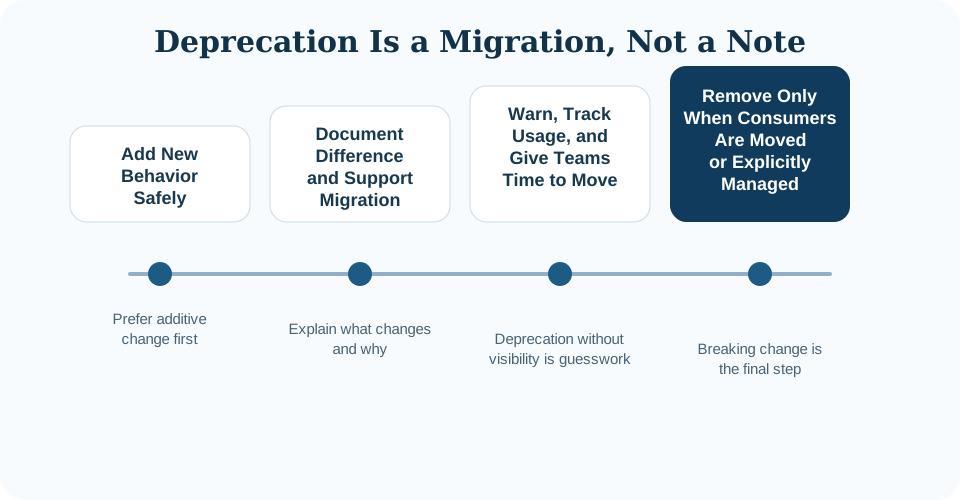
Deprecation Is a Migration Process
Deprecation is not a sentence in documentation. It is a coordinated migration.
A reasonable deprecation flow looks like this:
- introduce the replacement
- document the difference clearly
- communicate timelines early
- expose usage metrics if possible
- warn consumers before removal
- remove only when you know who is still using the old path
If you cannot identify consumers of a contract, your ability to deprecate safely is already weaker than you think.
URI Versioning vs Header Versioning
Most teams eventually debate where versioning belongs.
Common approaches:
/v1/orders- custom headers
- media-type negotiation
The truth is less exciting than the debate. The best choice is usually the one your consumers can understand, test, and operate reliably. For many teams, explicit URI versioning wins because it is easy to see, easy to log, and easy to debug. Header-based versioning can work, but it is often less obvious in tooling and harder to reason about operationally.
Again, clarity beats cleverness.
Designing APIs for Multiple Consumers
The moment an API serves more than one consumer type, design shortcuts start showing.
A web frontend often wants responsive list views and partial data refreshes. A mobile client cares more about payload efficiency and release coordination. Third-party consumers need stability, documentation, and predictable limits. Internal services may care most about machine readability and failure semantics.
The mistake is trying to please all of them with inconsistent endpoint behavior. That usually creates an API where each consumer type gets special cases bolted onto the same contract.
Better options include:
- keep core resource models consistent
- allow query-level shaping where it is genuinely useful
- document consumer-specific guidance without forking basic semantics
- avoid exposing backend implementation churn to clients
This is where discipline matters. If web wants one response shape, mobile wants another, and partners want a third, the first question should not be "how many variants can we support?" It should be "what is the stable contract underneath these needs?"
Sometimes the answer is separate endpoints for materially different workflows. Sometimes it is field selection or sparse responses. Sometimes it is admitting that one API should not do everything.
But the solution should be deliberate, not accumulated.
A Practical API Review Checklist for Teams
Most teams review API changes too narrowly. They check whether the endpoint works and whether the implementation is correct. That is necessary, but incomplete.
A useful API review asks contract questions.
Before shipping an endpoint or a change, review it like this:
| Question | Why it matters |
|---|---|
| Is the name obvious to a new consumer? | ambiguous naming becomes permanent support cost |
| Does the response shape feel consistent with the rest of the API? | inconsistency forces endpoint-specific client logic |
| Does the list behavior support growth? | missing pagination and filtering become painful later |
| Can consumers distinguish validation, auth, conflict, and server errors? | vague errors create brittle retry and UI behavior |
| Is this change additive or breaking? | breaking changes create migration and rollout cost |
| Can writes be retried safely? | distributed systems will eventually retry |
| What happens when another team depends on this field next quarter? | future change cost starts at first adoption, not scale |
That review lens catches problems much earlier than style-guide arguments.
A Few Common API Design Mistakes That Look Small at First
Some issues are worth calling out because they seem minor when shipped and expensive later.
Returning Different Shapes for Similar Resources
If /users returns one list envelope and /orders returns another, consumers have to memorize exceptions for no meaningful reason.
Treating Null, Missing, and Empty as the Same Thing
These are not always equivalent. A missing field, a field explicitly set to null, and an empty array can all mean different things. If your API uses them loosely, clients will guess.
Leaking Database or ORM Structure
A response optimized for your persistence layer is not automatically a good consumer contract. Database joins, internal IDs, and storage-driven naming often create ugly external APIs.
Making Errors Human-Readable but Not Machine-Readable
A string is not a contract. Clients need stable error codes.
Shipping Unbounded Endpoints
If a list endpoint can return effectively infinite data, the contract is incomplete.
Changing Behavior Without Changing Shape
Some of the worst breakages are invisible in docs. Same path, same fields, different semantics. Those changes are harder to spot and often more dangerous than explicit version bumps.
The Durable Principle
The job of API design is not to make the backend feel neat. It is to make other teams successful without constant coordination.
That means thinking beyond the first consumer. It means assuming growth, retries, misunderstandings, and slow upgrades. It means designing contracts that remain understandable when the engineers who built them are no longer in the room.
Good API design is not about winning a standards argument. It is about reducing friction over time.
If a consumer can use your API correctly without knowing your internal implementation, without guessing at failure behavior, and without fearing routine changes, you are doing the job well.
Comments
Join the discussion on GitHub.